The warning label on the back of a residential carbon-monoxide alarm typically reads UL 2034 Listed. That Listing is a real, valuable assurance — it means the device has been certified by Underwriters Laboratories to sound within defined time windows at three fixed concentrations: 70 PPM, 150 PPM, and 400 PPM. It is the baseline every Listed residential CO alarm in the United States must meet.
What UL 2034 does not require is any response below 70 PPM. The standard was written deliberately, with stakeholder input from fire services and gas utilities, to prevent nuisance alarms in gas-heated homes. The trade-off is that a Listed alarm can legally remain silent at concentrations where the US Centers for Disease Control documents measurable symptoms — headaches, dizziness, and impaired concentration — particularly in children, older adults, and people with cardiovascular or respiratory conditions.
A supplemental low-level monitor does not replace the Listed alarm. It sits alongside it, displays a numerical PPM readout from 0 PPM upward, and gives you a second data point. The AirGuard described below is one such monitor.
Section IThe 70 PPM rule, explained plainly.
Underwriters Laboratories standard UL 2034 governs every residential CO alarm sold in the United States. To earn the Listing, a detector must sound at 70 PPM within 60 to 240 minutes, at 150 PPM within 10 to 50 minutes, and at 400 PPM within 4 to 15 minutes. Below 70 PPM, the standard permits the device to remain silent indefinitely — a deliberate choice made to reduce nuisance alarms in gas-heated homes.
Public health guidance puts the onset of measurable symptoms lower than that. The US Centers for Disease Control documents headaches, dizziness, confusion, nausea and fatigue at low-level exposure — particularly in children, older adults, and anyone with cardiovascular or respiratory conditions. A supplemental low-level monitor does not change the UL 2034 Listed alarm's design. It simply adds a numerical readout from 0 PPM upward so you can see the concentrations a Listed alarm is permitted to ignore.
Section IIDo your homework before you buy.
Any residential CO alarm — Listed or not — is worth checking against the public recall record before you install it. The CPSC (US Consumer Product Safety Commission) maintains a free, searchable database of recalls for every major safety-product category, and every major US CO-alarm brand (Kidde, First Alert, Universal Security Instruments, and others) has had at least one recall in the past two decades affecting specific date codes. Find the date code on the back of your current alarm and search for it.
Search the CPSC recall database →
Historical recalls on the CPSC database are not a judgement on any manufacturer's current products. Modern Kidde, First Alert, and Google Nest residential CO alarms are UL 2034 Listed and remain the category leaders for code-compliant life-safety protection. If you own a Listed alarm from any reputable brand, inside its rated sensor life, keep it installed. A supplemental low-level monitor sits alongside a Listed alarm — never instead of it.
Independent coverage of this product category.
Several independent review sites have published analyses of the supplemental / low-level CO & gas detector category in 2026. These sites are not operated by us and we have no relationship with them — they're a second opinion you can check before you decide, especially if you are also cross-shopping competing products that make certification or performance claims.
Section IIIThe AirGuard — supplemental low-level CO & gas monitor.
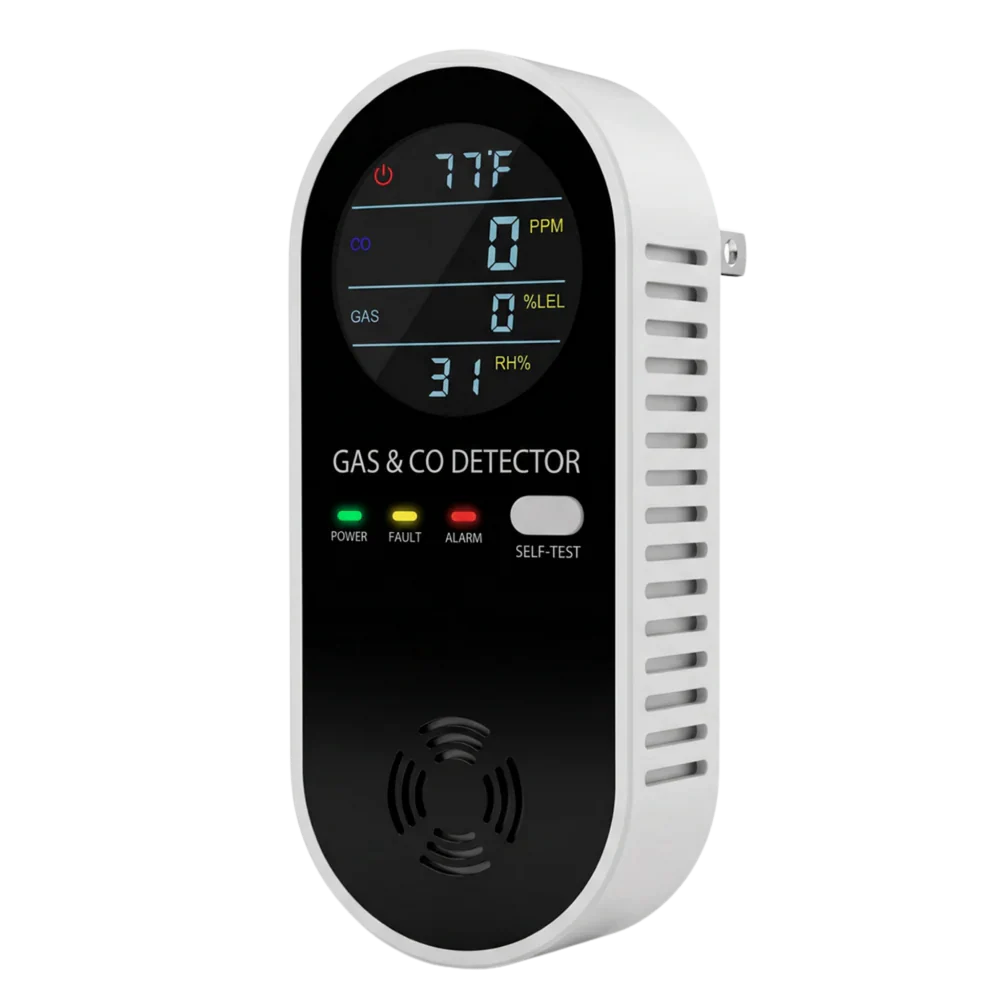
AirGuard by Primo Goods
- Digital readout from 0 PPM upward (display range 0–1000 PPM for CO)
- Detects carbon monoxide, natural gas, and propane / LPG (combustible gas)
- Electrochemical sensor (manufacturer description)
- Plugs into a standard US wall outlet — no batteries required
- Onboard temperature and humidity readout
- Audible 85 dB alarm with visual flashing indicator; CO alarm trigger 150 PPM (per retailer)
- Lifetime warranty; 100-day return window
Specifications above are drawn from the manufacturer's product page. Please see the safety disclaimer below before installing.
Before you install the AirGuard — please read.
The AirGuard is a supplemental low-level monitor. It is not a UL 2034 Listed life-safety alarm. We have not been able to find an active UL 2034 Listing for this product in the UL Product iQ database, and the manufacturer does not claim UL 2034 Listing on its own product page.
This device does not replace the UL 2034 Listed (or equivalent CSA 6.19 / EN 50291 Listed) CO alarm that your local building code requires. Install the AirGuard in addition to — never instead of — a code-compliant Listed alarm. If you do not currently have a Listed CO alarm installed, buy and install one first; a Listed alarm is the single most important piece of residential CO protection.
Why we still recommend it as a supplemental monitor: a Listed alarm is engineered to alarm at 70 PPM or higher, within windows measured in tens of minutes to hours. A numerical-readout monitor like the AirGuard gives you visibility of concentrations below that threshold — the concentrations a Listed alarm is designed not to respond to.
The AirGuard is a useful second data point for anyone who wants a visual low-level CO readout in their kitchen, near a gas-burning appliance, or in a hallway outside bedrooms. Use it as a supplement to, not a replacement for, a Listed alarm.
Section IVHow a supplemental low-level monitor behaves — illustrative demo.
Illustrative simulation, not a certified test result. Click the detector to plug it in, then strike the match or release the propane to see how a low-level monitor would respond to rising CO or combustible-gas concentrations. The numbers, alarm thresholds, and response curves in this simulation are chosen for clarity — they are not a measured claim about the AirGuard's actual response in real-world exposure. Per the manufacturer, the AirGuard's audible CO alarm triggers at 150 PPM.
Live readings
Illustrative simulation only. This device is intended as a supplemental monitor and does not replace UL-listed smoke or CO alarms required by local building codes. Audio is synthesised — please unmute your device.
A Listed alarm for code compliance. A supplemental monitor for visibility below the threshold.
UL 2034's 70 PPM silence threshold is not going to change soon, and a Listed alarm is still the single most important piece of residential CO protection. On top of that Listed alarm, a supplemental low-level monitor gives you a numerical readout of the concentrations the Listed alarm is permitted to ignore. The AirGuard is one such monitor — not a certified life-safety alarm, but a useful second data point.
View the AirGuard →Frequently asked.
Is the AirGuard UL 2034 Listed?
No. The AirGuard is not UL 2034 Listed. We searched UL Product iQ and could not find a Listing for this product, and the manufacturer (primo-goods.com) does not claim UL 2034 Listing on its product page. We sell it as a supplemental low-level CO and combustible-gas monitor, not as a certified life-safety alarm.
Does the AirGuard replace the CO alarm my building code requires?
No — do not use it as a replacement. Most US states and municipalities require UL 2034 Listed (or equivalent CSA 6.19 / EN 50291 Listed) CO alarms in residential buildings. The AirGuard is not Listed and does not satisfy those requirements. Install the AirGuard in addition to, never instead of, a Listed alarm. If you do not have a Listed alarm, buy one first — any reputable brand (Kidde, First Alert, X-Sense, Google Nest, etc.) sells current UL 2034 Listed models.
At what concentration does the AirGuard alarm?
Per the retailer listing (truvitalife.com), the AirGuard's audible alarm triggers at 150 PPM for carbon monoxide. The digital readout displays CO concentrations from 0 PPM upward within the 0–1000 PPM display range. Temperature and humidity are also displayed. Response times for specific concentrations are not published by the manufacturer.
Is the 70 PPM silence threshold real?
Yes. UL 2034 (the US standard governing residential CO alarms) requires Listed alarms to sound at 70 PPM within 60 to 240 minutes, at 150 PPM within 10 to 50 minutes, and at 400 PPM within 4 to 15 minutes. Below 70 PPM a Listed alarm is not required to sound at all. Canadian CSA 6.19 and European EN 50291 define comparable low-concentration delays. The standards are written this way deliberately, to reduce nuisance alarms.
How does a CO sensor "expire"?
Electrochemical CO sensors degrade with normal use and typically reach end-of-life between five and ten years after manufacture. A degraded sensor may still power on and pass a self-test but fail to respond to real CO exposure. Listed alarms are required to include an end-of-life chirp; replacement on schedule is what keeps a Listed alarm functioning as certified.
Do I need combustible-gas detection if I have a CO alarm?
If your home uses natural gas or propane for cooking, heating, or water-heating, combustible-gas detection is a useful addition. Raw methane and propane produce no carbon monoxide, so a CO-only detector will remain silent during a fuel leak. The AirGuard's combustible-gas readout is one way to get that visibility.
Why is my CO detector beeping?
CO alarms beep in five standard patterns: four quick beeps repeating means real CO (evacuate immediately); one chirp every 30–60 seconds is a low battery; five beeps every 30–60 seconds is end of life; a single long beep is a self-test; and irregular beeping is usually a malfunction or power interruption. We have a full troubleshooting guide: Why is my CO detector beeping? Every pattern, decoded →
Where do the product specifications on this page come from?
The AirGuard specifications shown on this page are drawn directly from the manufacturer's own product page (primo-goods.com) and from a second retailer listing the same unit. We have not independently chamber-tested the device. Please cross-check any specification that matters to your purchase against the manufacturer's listing before you buy.
Customer reviews.
Real reviews from verified customers who purchased the AirGuard through this site will be published here as they come in. We do not seed, script, or edit customer reviews — only genuine submissions received through the form below will appear, and only after the customer confirms publication consent.
Submit your own review.
If you purchased the AirGuard through this site, share your experience. We'll verify the purchase, confirm you're happy for your review to be published, and if approved, publish it under your first name, last initial, and month of installation. We will never invent, edit, or reorder reviews.
Contact us.
Order questions, return requests, specification questions, or commercial enquiries can be directed to support@codetectorreviews.com — or use the form below. We reply within two working days.